Mercedes McCambridge: A Voice of Strength in Recovery
An Academy Award-winning actress who used her voice—on screen and off—to challenge stigma and champion recovery long before it was widely accepted.
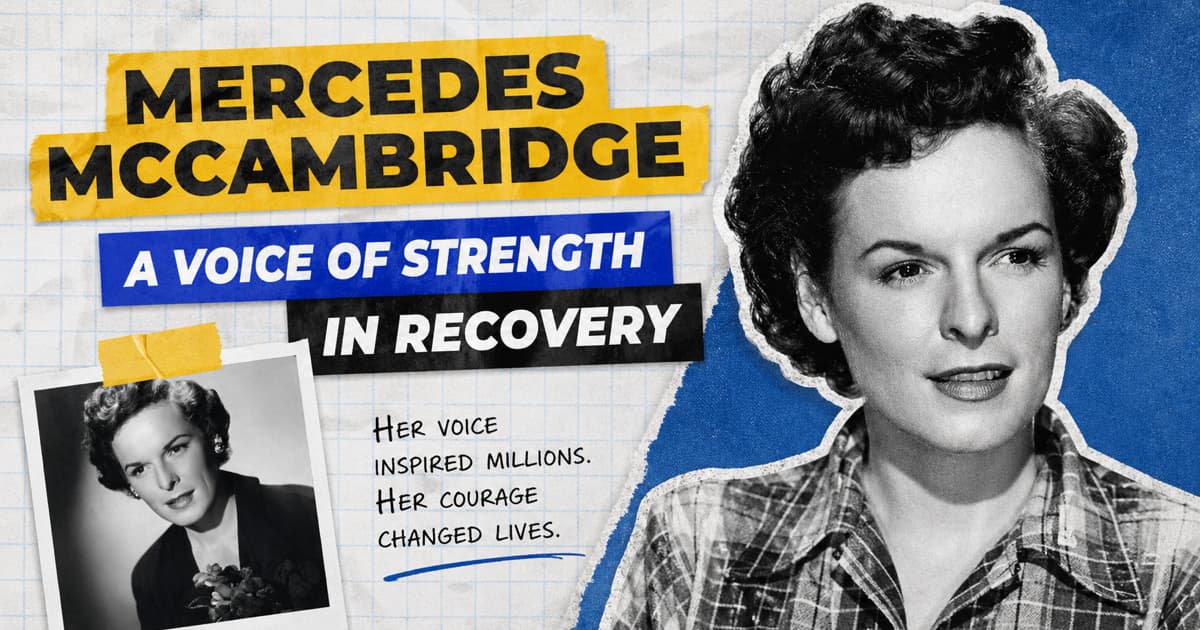
Mercedes McCambridge was one of the most distinctive voices in American film and radio — and one of the earliest public figures to speak openly about recovery, at enormous personal cost.
Before she ever appeared on screen, McCambridge built a successful career in radio during the late 1930s and 1940s. By the time she graduated from Mundelein College in 1937, she had already been signed to a five-year contract with NBC Radio, and she quickly became a standout performer across dozens of series — her powerful voice and emotional range in high demand throughout the era. Orson Welles famously called her the greatest living radio actress.
She later transitioned to film, earning an Academy Award for Best Supporting Actress — along with a Golden Globe for Best Supporting Actress and New Star of the Year — for her very first feature film role, as Sadie Burke in All the King's Men (1949). Her career continued with memorable performances in Johnny Guitar (1954), Giant (1956), for which she received a second Academy Award nomination, and Suddenly, Last Summer (1959).
But behind her success, McCambridge struggled deeply with alcoholism for many years. Her drinking contributed to two divorces, multiple hospitalizations, and two suicide attempts. It was not until 1969 — twenty years after her Oscar win — that she achieved sobriety, after years with Alcoholics Anonymous. Her path to recovery was long and hard-won.
Once in recovery, McCambridge made the courageous decision to speak publicly about her experience — and it came at a real price. Also in 1969, she was approached by Senator Harold Hughes to testify before a Senate subcommittee on alcoholism. She agreed, becoming one of the first public figures to openly declare her struggle with the disease before Congress. The consequences were severe: she estimated that her testimony cost her approximately one million dollars in lost television appearances, film roles, and product endorsements. Notably, her decision to go public also meant leaving Alcoholics Anonymous. As she put it herself: "I'm just not anonymous — but I bow very low in admiration for what they are doing." She did it anyway.
At a time when addiction was still widely viewed as a moral failing, McCambridge insisted on framing it as an illness — treatable, and worthy of compassion. "I believe I had little chance of avoiding my disease," she said in a 1981 interview. "I am convinced I was born with a predisposition to the disease." She also spoke out about the particular stigma faced by women, noting: "Alcoholism in male performers is macho. But the woman alcoholic who is a performer has a rougher row to hoe."
Her advocacy was formally recognized at the highest levels. In January 1971, McCambridge met with the First Lady at the White House and was awarded a certificate for her volunteer work on behalf of the National Council on Alcohol Abuse and Alcoholism — a public acknowledgment, from the Nixon administration, of the groundbreaking advocacy she had been doing at significant personal sacrifice. Her broader humanitarian work earned her recognition at the White House on multiple occasions.
Her advocacy extended well beyond individual appearances. McCambridge served as chair of the National Council on Alcoholism's Alcoholism Information Week, and from 1975 to 1982 served first as a board member and then as president and CEO of the Livengrin Foundation, a residential rehabilitation center in Bensalem, Pennsylvania. Through her celebrity and her willingness to share her own story, she helped bring public recognition to addiction as a disease and encouraged others to seek treatment. The impact she was having was recognized by peers too: Dick Van Dyke credited McCambridge in 1974 with having "broke the ice for the rest of us," saying her openness enabled other celebrities to be more publicly honest about their own struggles.
By the time Operation Understanding took place in May 1976 — a landmark press conference organized by the National Council on Alcoholism, at which more than fifty prominent Americans publicly declared their recovery from alcoholism — McCambridge was already a seasoned recovery advocate with years of work behind her. She was among the participants, though notably, while most said they felt relieved by the disclosure, McCambridge described it as a painful process. Her presence at the event nonetheless reinforced its credibility and helped expand its reach.
Even outside of traditional acting roles, McCambridge's voice left a lasting mark on popular culture. She provided the voice of the demon in The Exorcist (1973) — a performance widely regarded as one of the most iconic and unsettling in film history.
Mercedes McCambridge died on March 2, 2004, at the age of 87. Her legacy is not only defined by her award-winning performances, but by her courage in speaking openly about addiction at enormous personal and professional cost — at a time when almost no one else would.
Her story is a powerful reminder that recovery is not just about survival — it is about building a life with honesty, integrity, and purpose.
Additional Reading
- Wikipedia – Mercedes McCambridge
- Loyola University Women and Leadership Archives – "Mercy for the Devil"
- Encyclopedia.com – McCambridge biography
- UPI Archives – Woman's World interview, 1981
- Points: Alcohol & Drugs History Society – Operation Understanding
- Recovery Review – Standing Up for Recovery
- Fandango – Mercedes McCambridge Biography