Buzz Aldrin: From the Moon to Recovery
From walking on the Moon to speaking openly about depression and addiction, Aldrin helped redefine what strength and recovery look like.

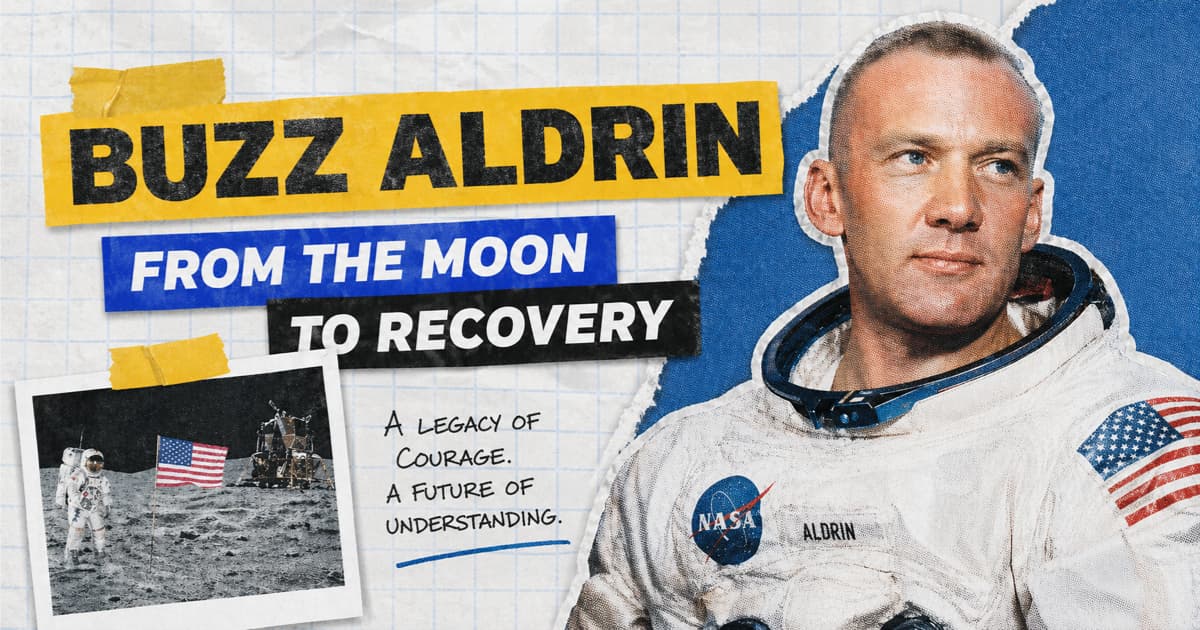
Buzz Aldrin is one of the most recognizable figures in American history.
As the second person to walk on the Moon during the Apollo 11 Moon Landing, Aldrin became a symbol of achievement, innovation, and courage. Before joining NASA, he graduated from the United States Military Academy, flew combat missions during the Korean War, and later earned a doctorate from Massachusetts Institute of Technology. He went on to serve as an astronaut on both Gemini 12 and Apollo 11.
But after the Moon landing, Aldrin struggled deeply with depression, loss of purpose, and alcoholism.
Like many astronauts returning from the intense pace and sense of mission that defined the space race, Aldrin found it difficult to adjust to everyday life after leaving NASA. He later described feeling emotionally adrift after achieving what many considered the greatest accomplishment imaginable. In his memoirs, he spoke candidly about the years that followed: depression, heavy drinking, family struggles, and repeated attempts to rebuild his life.
In 1973, Aldrin published his memoir Return to Earth, which openly discussed his depression and alcoholism in the years after Apollo 11. It was an unusually candid account for the time and helped introduce many readers to the reality that even national heroes could face addiction and mental health challenges.
Aldrin was especially important in the history of recovery advocacy because he was one of the first public figures of his stature to speak openly about the connection between depression and alcoholism. At a time when mental health and addiction were both highly stigmatized, his honesty challenged the idea that fame, intelligence, or success could protect someone from struggling.
In later interviews, Aldrin explained that alcohol was not the root of all of his problems, but rather something that prevented him from fully dealing with deeper issues like depression, family struggles, and fear of public life. He emphasized that sobriety was necessary before he could truly begin healing. That perspective helped make his story especially important because it highlighted the close connection between addiction and mental health.
When Aldrin joined Operation Understanding in 1976, he brought a perspective that few others could. He was not only one of the most famous people in America, but also someone whose story showed that addiction and mental health challenges can affect anyone — even a national hero who had walked on the Moon.
His presence helped broaden the conversation around recovery beyond alcoholism alone. Aldrin showed that recovery is often tied to grief, identity, depression, and the struggle to find purpose after major life transitions.
Although his recovery journey was not immediate or straightforward, Aldrin eventually stopped drinking in 1978 and remained sober for the rest of his life. He later wrote openly about rehab, attending Alcoholics Anonymous, and the long process of rebuilding his life.
In later years, Aldrin continued to speak openly about his struggles in books like Magnificent Desolation. Rather than hiding the difficult parts of his story, he emphasized that recovery, treatment, and asking for help were just as important as his accomplishments in space.
Buzz Aldrin’s legacy is not only that he helped humanity reach the Moon. It is also that he showed even the most accomplished people can struggle — and that there is strength in being honest about recovery.
Additional Reading: